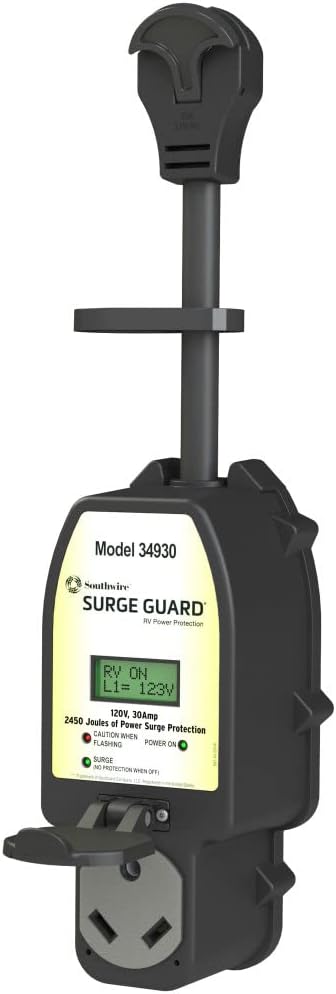
Article Type: Product Recommendation
Author: RV Pro Solutions (Certified NRVIA Inspector Insight)
Applies To: RVs equipped for 120/240-volt, 50-amp shore-power service
Overview
The Southwire Surge Guard 34951 is a portable full-protection device for 120/240-volt, 50-amp RV shore-power systems. It monitors both incoming power legs, disconnects the RV for specified unsafe conditions, and supports compatible wireless or Bluetooth monitoring options.
Southwire rates model 34951 at 50 amps with 4,200 joules of surge suppression. The unit monitors voltage and current, pedestal wiring faults, open-neutral conditions, overheating, and other specified conditions. Wireless information is convenient, but it does not replace inspection of the pedestal, plug, receptacle, cord, and strain relief.

Southwire Surge Guard 50A Portable RV Surge Protector (34951)
Check current price and availability.
Key Features
- Designed for 120/240-volt, 50-amp RV shore-power connections.
- Southwire-rated 4,200 joules of surge suppression.
- Monitoring for over- and undervoltage, open ground, open neutral, reverse polarity, overheating, and high neutral current.
- LCD status and compatibility with supported Southwire wireless/Bluetooth monitoring options.
- Automatic disconnect and delayed restoration after acceptable power returns.
RV Use Cases
- Checking unfamiliar 50-amp campground pedestals before energizing a large RV.
- Monitoring both legs of a 50-amp service during changing campground loads.
- Protecting sensitive RV electronics and appliances from the conditions detected by the device.
- Owners who want portable protection with compatible remote status information.
Practical Advantages and Limitations
Advantages:
- Monitoring both 50-amp service legs provides information a basic surge-only device does not supply.
- Wireless-capable status can make recurring voltage and fault checks more convenient.
- Automatic disconnect and delayed reconnect protect without a permanent hardwired installation.
Considerations:
- Remote or app features depend on compatible hardware, software, range, and current Southwire support.
- The portable unit is relatively bulky and needs a sound, properly supported pedestal connection.
- It cannot repair wiring faults, loose receptacles, overheated plugs, or defects inside the RV.
- Persistent faults, surge-failure indications, or heat damage require investigation and may require replacement.
Best Practices
- Inspect both sides: Check the pedestal receptacle, Surge Guard connectors, RV plug, cord, and strain relief for wear or heat.
- Connect with power off: Follow Southwire’s connection sequence before turning on the pedestal breaker.
- Verify both legs: Confirm normal voltage, current, and fault status before using high-demand appliances.
- Use remote data correctly: Treat wireless information as a monitoring aid, not a substitute for physical inspection.
- Stop on repeated faults: Disconnect and obtain qualified diagnosis rather than cycling or bypassing protection.
- Support and secure it: Keep weight off the receptacle, follow weather guidance, and protect the portable unit from theft.
Inspector’s Note (RV Pro Solutions Insight)
Campground electrical hookups aren't always as reliable as we'd like, so one thing I always recommend is investing in a good-quality RV surge protector with electrical monitoring capabilities. I consider it inexpensive insurance when connecting your RV to an unfamiliar power source. It's a relatively small investment compared to the potential cost of repairing damaged electrical components or appliances.
We've used different surge protectors over the years, and one thing I've really appreciated about the Surge Guard is how quickly it checks the incoming power before allowing electricity into the RV. I also like having a display that shows important information such as voltage, current draw, and any detected electrical faults. That way, you're not just plugging in and hoping everything is okay.
For me, it's about more than just surge protection. Having a device that can identify common electrical problems, such as low voltage, high voltage, or wiring faults, gives you an added level of protection and peace of mind. Not every surge protector offers these features, so it's worth paying attention to what you're buying.
My advice is to make a quality surge protector with electrical monitoring part of your regular campground hookup routine. It's a simple precaution that can help protect your RV's electrical system and potentially save you from some very expensive repairs down the road.
Check current price and availability.