
Article Type: Product Recommendation
Author: RV Pro Solutions (Certified NRVIA Inspector Insight)
Applies To: RVs equipped for 120-volt, 30-amp shore-power service
Overview
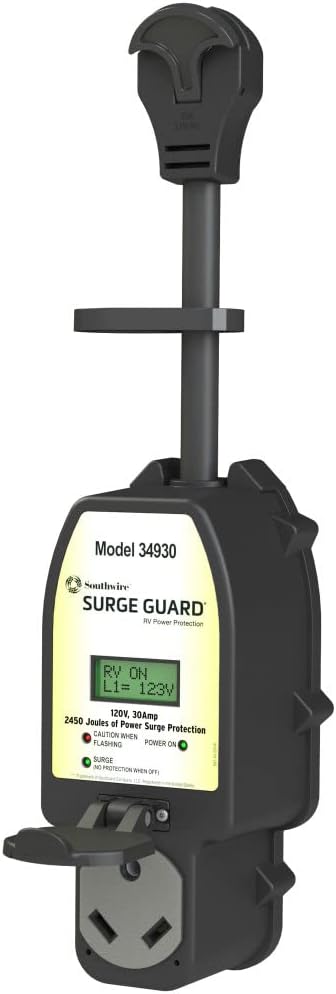
The Southwire Surge Guard 34930 is a portable full-protection device for 120-volt, 30-amp RV shore-power systems. It connects between the campground pedestal and the RV power cord, monitors incoming power, and disconnects the RV when specified voltage, wiring, overheating, or surge-related conditions are detected.
Southwire rates model 34930 for 30 amps, 3,600 watts, and 2,450 joules of surge suppression. Its LCD displays voltage and current information, while fault messages help identify conditions such as open ground, open neutral, reverse polarity, and plug or receptacle overheating. It is a protective layer, not a substitute for inspecting the pedestal and cord.

Southwire Surge Guard 30A Portable RV Surge Protector (34930)
Check current price and availability.
Key Features
- Designed for 120-volt, 30-amp RV shore-power connections.
- Southwire-rated 2,450 joules of multi-mode surge suppression.
- Monitoring for over- and undervoltage, open ground, open neutral, reverse polarity, and overheating.
- LCD information for incoming voltage, current draw, operating status, and detected faults.
- Automatic power restoration with a protective delay after acceptable conditions return.
RV Use Cases
- Checking an unfamiliar 30-amp campground pedestal before energizing the RV.
- Continuous monitoring during short stays, seasonal sites, or full-time occupancy.
- Protecting RV electronics and appliances from the specific conditions detected by the device.
- Troubleshooting repeated power interruptions without bypassing the protection.
Practical Advantages and Limitations
Advantages:
- The portable design can be used without modifying the RV’s internal wiring.
- LCD fault information provides more detail than a basic surge-only indicator.
- Automatic disconnect and delayed reconnect reduce the need for manual cycling after some power events.
Considerations:
- The unit protects only against conditions within its design and ratings; it does not correct pedestal or RV wiring defects.
- Its body and cord require space at the pedestal and should not hang from a loose receptacle.
- Portable equipment may be exposed to theft, weather, impact, and damaged connectors.
- A surge-failure or persistent-fault indication requires investigation and may require replacement or qualified electrical service.
Best Practices
- Inspect before connecting: Check the pedestal receptacle, breaker, plug blades, cord ends, and housing for damage or heat.
- Connect in sequence: Turn the pedestal breaker off, connect the Surge Guard and RV cord, then energize according to Southwire instructions.
- Read the display: Confirm normal voltage and fault-free status before operating heavy RV loads.
- Do not bypass faults: Disconnect and have the source or RV evaluated when the unit repeatedly refuses power.
- Protect the connection: Keep the assembly supported, weather-protected as directed, and secured against theft.
- Store it carefully: Disconnect with the breaker off, inspect for heat damage, and store the unit dry with the cord loosely arranged.
Inspector’s Note (RV Pro Solutions Insight)
One thing I always recommend to RV owners is investing in a good-quality surge protector before heading out on their first camping trip. Campground electrical pedestals can vary quite a bit in condition, and you never really know what you're connecting to until you check the power. For me, a Surge Guard is an easy way to add an important layer of protection between the campground's electrical supply and your RV.
What I like about a good Surge Guard is that it does more than simply protect against power surges. Models equipped with electrical monitoring can check incoming power for problems such as high or low voltage, open grounds, and wiring faults before allowing electricity into the RV. Some models also provide a display showing voltage, current draw, and fault information, which can be especially helpful when you're trying to figure out what's happening at the campground pedestal.
Over the years, I've learned that electrical problems aren't always obvious. Everything might appear to be working normally, but that doesn't necessarily mean the incoming power is within acceptable limits. Having a device that monitors those conditions and can automatically disconnect power when certain electrical problems occur is something I consider well worth the investment.
My advice is to make a quality surge protector part of your regular campground setup routine. Choose a model with the protective features you need, rather than buying based on price alone. It's a relatively inexpensive way to help protect your RV's electrical system, appliances, and other sensitive electronics from potentially costly damage.
For us, it's one of those accessories that simply makes sense to have. The cost is small compared to what an electrical problem could end up costing you.
Check current price and availability.

