
Article Type: Product Recommendation
Author: RV Pro Solutions (Certified NRVIA Inspector Insight)
Applies To: RV and marine freshwater hookups using standard garden-hose connections
Overview
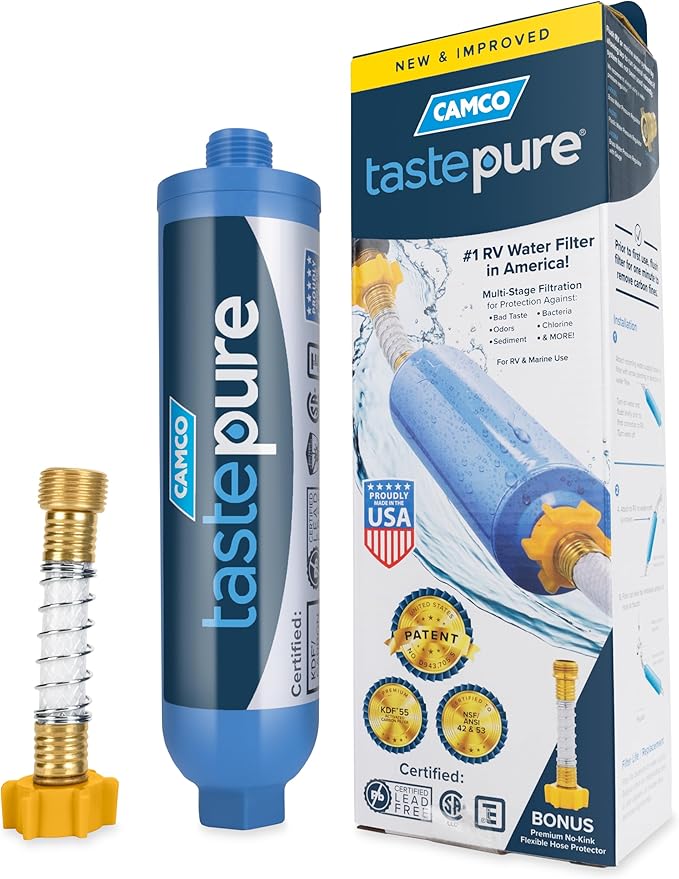
The Camco TastePURE model 40043 is an inline RV and marine water filter supplied with a flexible hose protector. Camco identifies it as a KDF filter and markets it for improving taste and odor and reducing listed impurities in campground or marina water. The inline format connects between the water source and the RV freshwater hose.
This filter does not make an unknown or unsafe water source potable, and it should not be described as removing every contaminant or bacteria. Performance and service life depend on source-water quality, volume, flow, storage, and the manufacturer’s current instructions. Replace the filter when performance declines or the stated service limit is reached.

Camco TastePURE RV/Marine Water Filter (40043)
Check current price and availability.
Key Features
- Inline KDF filtration is intended for RV and marine freshwater hookups.
- Flexible hose protector reduces strain at the filter connection.
- Standard garden-hose fittings support common spigots, hoses, regulators, and RV inlets.
- Compact disposable format requires no permanent installation.
- Camco identifies model 40043 as made in the United States.
RV Use Cases
- Campground city-water hookups where taste, odor, or sediment is a concern.
- Filling an RV freshwater tank from an approved potable-water source.
- Marina or boat freshwater connections using standard garden-hose fittings.
- Temporary outdoor water connections where an inline filter is more practical than a canister system.
Practical Advantages and Limitations
Advantages:
- Simple inline setup adds filtration without modifying the RV plumbing.
- Compact size is convenient for travel and seasonal use.
- The hose protector helps reduce leverage and kinking near the filter body.
Considerations:
- The filter does not certify an unknown source as safe drinking water.
- Flow can decline as sediment accumulates or if the source pressure is low.
- Actual service life varies with water quality and usage rather than a single universal calendar interval.
- Freezing, prolonged heat, contamination, or improper storage can damage the filter or reduce confidence in it.
Best Practices
- Start with potable water: Use only a source identified and maintained for drinking-water service.
- Follow connection order: Install the pressure regulator and filter in the sequence recommended for the RV and filter system.
- Flush before connection: Follow Camco’s current flushing instructions before sending water into the RV.
- Check for leaks: Inspect the hose washer, filter body, and both threaded connections after pressurizing.
- Protect from temperature extremes: Do not allow the filter to freeze, overheat, or remain pressurized when unattended.
- Replace by condition: Follow the manufacturer’s current service guidance and replace the filter after questionable storage, damage, contamination, or noticeable performance decline.
Inspector’s Note (RV Pro Solutions Insight)
If you’re looking for an affordable and simple way to improve your water quality while camping, I’d recommend starting with an inline water filter. They’re inexpensive, easy to install, and can help reduce sediment, chlorine taste, and odors, depending on the type of filter you choose. You don’t necessarily need to invest in an expensive multi-stage filtration system to see some benefits.
For our RV, we use an inline filter whenever we fill our freshwater tank at a campground, even if it’s somewhere we’ve stayed before. Of course, we always make sure the water source is designated as potable first. That filtered water is what we use for everyday things like cooking, washing dishes, and showering.
When it comes to drinking water, we take it a step further and use an additional drinking-water filter for the family.
My advice would be to start with a good-quality inline filter and see how it works for your needs. It’s a practical, economical way to add a layer of filtration without making your setup complicated. Just remember, an inline filter can improve water quality, but it doesn't necessarily remove harmful bacteria or other contaminants. It should never be relied on to make an unknown or unsafe water source safe to use.
Check current price and availability.


